


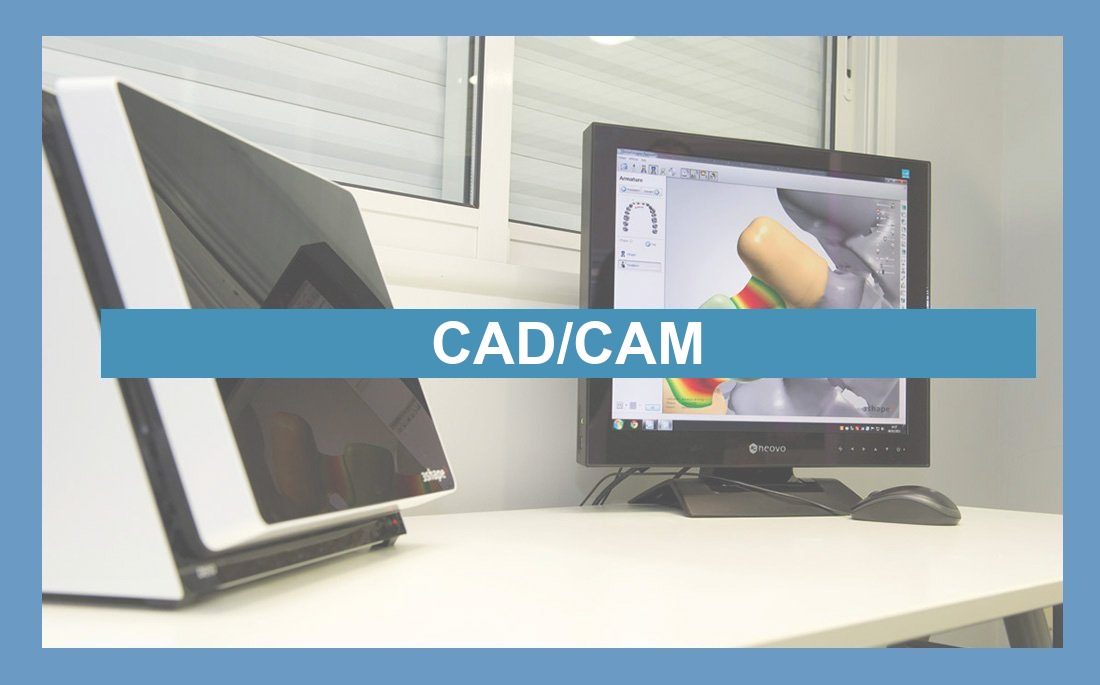
CAD/CAM: the must-have of modern dentistry
1 Introduction: a brief history
Initially developed in the aeronautical and automobile industry in the 1960s, in order to standardize the production of routine, repetitive forms, CAD/CAM's dentistry application was considered an ambitious and somewhat fanciful project, each prosthetic piece being unique and specific to the individual patient.
In 1973, François Duret had the idea of transferring this concept to making dental prosthetics, and thus became the inventor of dental CAD/CAM, the foundations of which he discussed in his paper "Optical impression".
Thanks to the work of F. Duret, CAD/CAM was born and went on to revolutioniize the world of dentistry.
This technology has continued to evolve and improve ever since in the field of odontology, carving itself a reputation as an indispensable tool in the digital age.
Definition
The dental CAD/CAM chain (Computer Aided Design / Computer Aided Manufacturing) is a collection of coordinated technological resources (CAD, CAM) for recording (acquisition) analog clinical data in digital format and virtual modeling (CAD), before producing a tangible bespoke medical device (CAM).
It therefore concerns all odontology specialties requiring bespoke medical devices.
2 Digital flows and components in the CAD/CAM chain
A full CAD/CAM dental chain comprises 4 links separated by interfaces:

1st link: Data acquisition
Acquisition involves digitizing clinical data, followed by a processing stage. This can be done directly in the mouth using an intra-oral camera, or by scanning plaster moulds or impressions.

Figure 1 — Optical intra-oral camera
2nd link: CAD
CAD (computer aided design) is the process of creating virtual objects using a graphic representation. It includes a stage prior to the prosthetics design stage involving the "post-processing" of points obtained during the acquisition stage using optical impressions. At the end of this stage, the virtual model appears on the screen after digitization.
3rd link: CAM
CAM (computer aided manufacturing) is the process of making objects; transforming a virtual object (created by CAD) into a material object. This involves dedicated software to generate toolpaths, determining the tools' positions during manufacturing.
4th link: NCMT
This is the fourth and last component in the CAD/CAM dental chain, and is responsible for manufacturing. It's a programmable numerical control machine tool.
The manufacturing process is conducted either:
- By subtraction (by removing materials): we talk about subtractive manufacturing, primarily machining via milling.
- By addition (by adding materials): we talk about additive manufacturing, better known as 3D printing. The main additive processes for formatting are stereolithography (SLA), Fused Deposition Modeling (FDM), selective laser melting (SLM) and selective laser sintering (SLS).

Figure 2 — 3D printer (SLA technique)
| SLA | FDM | SLM | SLS |
|---|---|---|---|
| Stereolithography via photopolymeriization | Fused Deposition Modeling | Selective laser melting | Selective laser sintering |
| Chemical process — Gradual polymeriization using laser beams from a sensitive special resin. Once the layer has solidified, the laser continues to sweep the liquid resin basin to polymeriize it and make it harden, until the entire object has been formed in successive layers. | Physical process — Deposition of a thermoplastic polymer filament, heated to its plasticity temperature, layer by layer through a nozzle to form the desired object. | Physical process — Deposition of successive layers linked to a laser sweeping a metal powder bed to melt it until the metal piece is formed. | Physical process — Deposition of successive layers linked to a laser sweeping each layer to enable its sintering until the desired model is obtained. |
3 Direct, semi-direct or indirect CAD/CAM
Developments in CAD/CAM mean that we are now in a position to distinguish three different methods:
Direct CAD/CAM
Enables the practitioner to construct a prosthesis in one single session. All stages are carried out in their surgery. The intra-oral optical impression is processed on site until the restoration is produced; inlays, onlays, ceramic veneers, single crowns or temporary bridges.
Semi-direct CAD/CAM
Requires at least one visit to a dental surgery; the data acquired by the practitioner can be processed in the surgery to carry out the CAD, or transmitted to an online laboratory or machining center in real time, for immediate interaction with the manufacturer, to produce the infrastructure as well as the cosmetic element.
Indirect CAD/CAM
The practitioner produces a standard manual chemical impression that they then send to the prosthetist or machining center. All stages in the chain are therefore outsourced.

Figure 3 — Direct, semi-direct and indirect CAD/CAM
Semi-direct and indirect techniques require laboratories or machining centers to construct more complex restorations using materials that are more difficult to work with in a dental surgery.
Open chain versus closed chain
This concept defines the ability to intervene in a particular link of the CAD/CAM chain, or to change the link in a digital flow.
Closed system: all chain components are stipulated by the manufacturer. Once the acquisition stage is complete, nothing can exit the chain and no data export is possible, except for the end product.
Open system: the practitioner has the option to acquire the various links from different manufacturers, in line with their needs and the specific characteristics of each component. It is possible to exit the chain after each stage and also to export files. This type of system makes it possible to modify a whole link or certain parameters, and to access the data obtained.
Compatibility concept
It is the "compatibility" between the various selected links in the chain that dictates the ability of two digital systems (software or hardware) to exchange data without altering the information. This represents the minimum requirement to integrate two consecutive digital systems in the same digital flow. It constitutes a major criterion when choosing a CAD/CAM chain.
4 Materials in CAD/CAM techniques
Compared with traditional techniques, CAD/CAM offers a more varied palette of materials in order to fulfill all restoration types. The materials used depend on the process adopted — manufacturing by subtraction or addition — and are chiefly aesthetic ones: resins, all kinds of ceramics (feldspathics, vitro-ceramics, aluminous, alumina and zirconia crystalline) and hybrid materials.
Practitioners now have blocks of full-tone materials as well as shaded multi-chromatic blocks in one direction (Empress CAD Multi…) or several directions (MkII Real Life), and even with variable translucency levels (Empress CAD and eMax CAD). Manufacturers also offer dyed crystalline ceramic blocks.
This is how CAD/CAM has been able to promote materials other than the metal alloys and products used in traditional techniques, leading to the standardiization of all-ceramic restorations.
5 Applications of CAD/CAM
The use of CAD/CAM technology has led to the improvement of existing therapeutic solutions and paved the way for new solutions.
The application fields for CAD/CAM range from restorative dentistry and prosthetics to implantology, oral surgery and orthodontics.
Fixed prosthetics and restorations
This technique can be used for indirect restorations (inlays, onlays), single and multiple fixed prostheses, inlay cores, veneers, supra-implantary fixed prostheses (bonded or screw-in), and even temporary prostheses.
Removable prosthetics
It can also be used for removable prostheses and removable prostheses on implants. For adjoint prosthetics, dedicated software is capable of designing complete prosthetic bases and metal partial prosthesis frames, and of simulating the patient's occlusion on a virtual articulator.
It is also used to make maxillo-facial prostheses. The manufacturing processes and materials differ for each application, but the digital flow remains largely the same.
Implantology
In implantology, CAD/CAM can be used to make individualiized abutments, customized implant bars and implant surgical guides to guide the surgical procedure during implant placement.
Orthodontics
CAD/CAM in orthodontics has seen the development of a new treatment for correcting malocclusions using invisible alignment trays, providing an alternative to conventional orthodontic treatment. This software can archive digital models obtained using optical impressions, schedule treatments by producing set-ups, and harness cephalometric data.

Figure 4 — Invisible alignment tray
With CAD/CAM, the bonding stage is optimized by making an indirect bonding tray that can transfer the position of orthodontic brackets quickly and accurately onto the patient's teeth. CAD/CAM can also be used to make osteotomy and repositioning guides, DFO braces, interception devices and models.

Figure 5 — Indirect orthodontic bonding tray
6 Advantages of CAD/CAM
For the practitioner
Speed, time savings and comfort: The use of optical impressions eliminates a certain number of stages in the prosthetic chain. This translates into speedy and efficient operations, therefore saving considerable time and generating a standardized protocol with less need to fine-tune restorations, while still ensuring reliability.
Productivity and profitability gains: Aside from productivity in the surgery, which is optimized by shorter manufacturing timeframes, the number of sessions is reduced to just one single session using direct CAD/CAM. This guarantees day-to-day profitability for the surgery.
Greater accuracy, consistency and traceability: The rational protocol posited by CAD/CAM, which reduces the number of stages in the prosthetic chain and therefore the risk of error, makes restorations more accurate. Furthermore, digital ensures consistency of medical devices and optimizes their traceability.
Expanded therapeutic arsenal: The practitioner has new materials and processes at their disposal, including 3D printing, which allows them to diversify the actions undertaken and the treatments issued on a daily basis.
Improved brand image: The wide range of materials and new therapeutic solutions afforded by CAD/CAM mean that practitioners can set themselves apart from the competition by enhancing their work and their surgery's technical platform, and offer their patients a more modern form of dentistry.
For the patient
Better quality treatments: The CAD/CAM technique means that patients can now enjoy restorations that are not just more aesthetically pleasing, biomimetic and biocompatible but also more accurate. Dematerialiizing tasks throughout the prosthetic chain avoids accumulating the inaccuracies inherent in traditional techniques.
Patient comfort: Eliminating the physical impression stage (alginate or silicone), often deemed too aggressive by patients, has very significant benefits in CAD/CAM. Using just one anesthetic instead of two, and eliminating the temporary stage are undeniable advantages. Sessions are shorter and more comfortable, and there are fewer of them; some treatments can even be carried out in one single session including preparation, thanks to direct CAD/CAM.
Reduced cost: Shortened timeframes and reduced human resources required to produce CAD/CAM restorations, coupled with a burgeoning market, have seen a fall in the cost of these restorations.
For the prosthetist
Advantages for the surgery become advantages for the laboratory. The prosthetist instantly receives a highly accurate digital impression, which reduces the source of errors that can sometimes occur through subjective interpretations, thereby making the whole process speedier and more productive.
Patient-practitioner-prosthetist communication
Practitioner-Prosthetist: With semi-direct and indirect CAD/CAM, the practitioner communicates with the specialist laboratory in real time online, which results in a meaningful dialog between both parties in their relative fields of expertise.
Patient-Practitioner: The digital data flow makes communication with the patient much easier. The justification for a particular therapeutic choice and treatment plan is given by a straightforward and accurate visual explanation, with images displayed on the screen. Patients are then able to discuss with the practitioner the shade and form of the teeth, and the technique to be used. By dispensing with medical jargon, patients are better able to virtually visualize the end result of their treatment, and are reassured about the quality of this treatment.
Ecological benefits
Reducing the volume of materials used in conventional techniques and minimizing waste, particularly through the use of optical impressions and additive manufacturing, has an undeniably positive impact on the environment.
7 Limitations of the CAD/CAM technique
Despite the numerous advantages mentioned previously, a considerable number of practitioners remain reluctant to adopt CAD/CAM in their day-to-day practice. There are several reasons for this:
- High investment and maintenance costs, especially for young practitioners or small surgeries. Nevertheless, market developments will eventually lead to a fall in these costs.
- Prosthetist partner not equipped
- Lack of interest in and time required to learn the CAD/CAM technique
- Aesthetic appearance of machined, stained ceramic often deemed inferior to the stratified ceramic used in traditional techniques
- Limited clinical indications
8 Conclusion
The advent of CAD/CAM has revolutioniized the world of dentistry. This technology has paved the way for new therapeutic possibilities, as well as the development of new materials. Despite the sharp growth it has experienced, the number of dentists using it in France remains low. For some, converting represents a major transition that will destabiliize their practices.
The undeniable improvements in accuracy, time and comfort for both practitioner and patient are reasons to encourage more dentists to take the plunge and embrace digital dentistry. When acquiring a dental CAD/CAM chain, it is important to choose appropriate equipment in terms of performance, ergonomics and, above all, compatibility.