


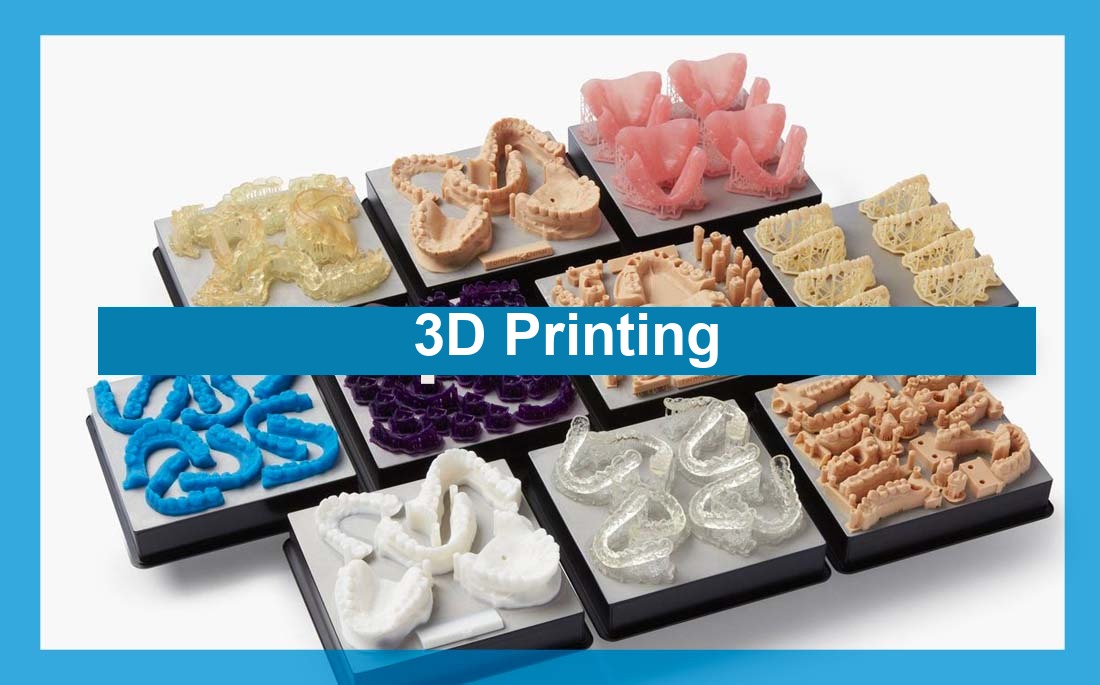
3D printing in dentistry
Technologies, applications and outlook of additive manufacturing in dentistry
1 Introduction and key figures
Developments in digital dentistry have seen the dental sector undergo tremendous change in recent years. In particular, additive manufacturing — "3D printing" — has enabled the dental industry to develop its use of digital technologies.
The dental sector is a market driver for 3D printing technology, as it responds to the issues of customization.
The dental 3D printing market in figures
In 2015, the 3D printing market for the dental industry was worth $780 million. According to SmarTech Publishing, a leading firm in market research for additive manufacturing, the medical sector (including dental) accounts for 11.3% of additive manufacturing technology users.
The firm also reports that the dental 3D printing market will grow to over $3.1 billion in 2020. This market is experiencing sharp annual growth estimated at over 35%, and is expected to reach $9.5 billion by 2027.
All of these promising figures demonstrate the various opportunities for additive manufacturing in this sector.
In this article on dental 3D printing, we detail the techniques, materials and key uses of 3D printing technologies in dentistry, explain the benefits and drawbacks of 3D printing for dentistry, and conclude with the prospects for this innovative technique.
2 3D printing technologies in dentistry
In industry, additive manufacturing is a process whereby a part is formed by adding material, stacked in a succession of layers. 3D printing is the consumer name for the collection of additive processes.
In the dental industry, several technologies and materials are used in additive manufacturing.
The forming process can be physical (fusion followed by solidification, sintering) or chemical (photopolymeriization).
The technique selected depends on the application required.
Below are the main procedures used in dentistry.
FDM (Fused Deposition Modeling) in dental 3D printing
The technique involves depositing a thermoplastic filament heated to the plasticity temperature of the molten polymer. The forming process is physical and uses thermoplastic materials (ABS or PLA).
FDM has the advantage of producing parts at low cost that require no post-processing. However, its drawbacks include lack of speed, accuracy and biocompatibility. It is therefore only suitable for creating dental master models for thermoforming orthodontic alignment trays, retention trays or whitening trays.
With the emergence of the newer thermoplastic material PEEK (PolyEtherEtherKetone), this process can now produce biocompatible dental solutions, in particular removable partial prostheses. This FDA-approved material boasts excellent chemical and mechanical resistance while being lightweight for added patient comfort. Metal-free, this prosthesis also has the advantage of being flavor-neutral.
SLA and DLP photopolymeriization in dentistry
This is the main additive manufacturing process used in the dental sector. It's a chemical procedure used in SLA (stereolithography) and DLP (Digital Light Processing) techniques.
SLA involves the formation of a 3D model using successive layers, with a laser that sweeps each layer into a photosensitive liquid bath and polymeriizes it. The materials used are thermosetting plastics and elastomers.
This technology offers resolution and accuracy levels considerably higher than FDM, with biocompatible materials — liquid resins approved by CE / FDA. The finish is much less complex, which reduces overall manufacturing time.
This technology makes it possible to change materials for use with a different application. It can be used to manufacture surgical guides, temporary prostheses, and burn-out elements such as stellite components.
Metal additive manufacturing for implants and prostheses
Depicted mainly by SLM (Selective Laser Melting) and SLS (Selective Laser Sintering), metal additive manufacturing is used to make implants, stellites and nickel-chrome copings.
This technology needs sustained production in order to cushion the sizeable investment required.
Metal machines will also require more significant post-processing work, thereby reducing productivity; in terms of unit cost, however, this technology remains considerably more attractive.
Process Materials
Selective Laser Melting (SLM)
or Laser Metal Fusion +++
Plastics
Ceramics
Selective Laser Sintering (SLS)
or Metal Laser Sintering +++
Thermoplastics (polycarbonate, polyamides, polyvinyl chloride)
Ceramics
FDM Fused Deposition Modeling Thermoplastics (ABS or PLA)
Stereolithography (SLA) Thermoset elastomers and plastics
3 Applications of 3D printing in dentistry
3D printing has been primarily adopted by dental professionals wanting to produce surgical guides, customized dental trays, burn-out resin parts, impressions for moulds and temporary dental crowns.
3D printing applications in dentistry fall into three categories:
Direct manufacturing of bespoke dental devices via 3D printing
These are mainly implant surgical guides that can guide the surgeon during the drilling process and respect the digital pre-implant plan, including implant location, angulation and depth.
Using class III biocompatible resins, it is also possible to print 3D trays that are comfortable and perfectly adapted to the patient's mouth, including whitening, bruxism and fluoride gel trays.
3D printing can also be used to make devices used in DFO, such as alignment and transfer trays, osteotomy guides and repositioning guides, as well as all kinds of orthoses and interception devices.
Devices for maxillo-facial surgery (genioplasty, rhinoplasty, epitheses) can also be printed in 3D.
3D impression printing for dental moulds using the lost-wax technique.
A 3D version of dental prostheses (crowns, bridges…) printed using burn-out resin is used to make a customized mold harnessing the lost-wax technique. The final prosthesis is obtained by pouring the desired material (ceramic, metal, etc.) into this mold.

Figure 1 A 3D printed dental crown (lost-wax technique)
Direct manufacturing of dental restorations and prostheses in 3D
Thanks to 3D printing, it is now possible to make temporary veneers, crowns and bridges with biocompatible resins. These restorations are perfectly adjusted to the patient's mouth, thanks to the high precision of 3D scanning and SLA or DLP resin 3D printers.
However, it should be noted that it is not yet possible to directly print permanent crowns or dental prostheses in 3D, either in resin or ceramic.
Metal additive manufacturing makes it possible to produce crowns, bridges and dental implants, as well as the metal part of dental stellites and the base of removable complete prostheses.
Which 3D printing technique for which dental application
Application Technique
Surgical guides SLA
Temporary prostheses SLA
DFO orthoses, interception devices, dental trays, models SLA
Maxillo-facial surgery (genioplasty, rhinoplasty, epitheses) and DFO: osteotomy guide and repositioning guide, e.g. orthognathic Le Fort surgery, mandibular reconstruction… SLA
Bases of removable complete prostheses
FDM
Metal frame for removable partial prostheses Metal additive manufacturing
4 Benefits, drawbacks and outlook
In today's prosthetics laboratories, it is not uncommon to see various solutions coexisting, both subtractive and additive, as part of a digital workflow strategy.
Using 3D printing to complement traditional machining methods offers many advantages.
A dematerialiized and simplified dental manufacturing process
Traditionally, prostheses were the result of collaboration between dentist and prosthetist. The advent of digital technologies has shaken up this traditional organization, by completely dematerialiizing working processes.
Both of these dentistry players are now part of a drive to modernize their tools, while retaining their expertise, which remains paramount.
By using additive manufacturing, it is possible to simplify the production chain through digital flows, optimize conditions and reduce prosthetic and dental mold manufacturing cycles, and consequently the delicate manual work stages.
Speed of prosthesis manufacturing via 3D printing
From digital dental impressions to manufacturing using 3D printing, the fully digital process requires only a few hours' work instead of the several days traditionally required. In some cases, these shorter manufacturing times mean that the patient is only called in once.
By reducing the number of man-hours, using additive manufacturing can reallocate these hours to work with greater added value, considerably raising productivity.
Profitability of 3D printing for the dental practice
3D printing has a high ROI, which explains its adoption by a large number of dental surgeons and prosthetists worldwide.
Today, over 50% of French prosthetics laboratories are fitted with 3D scanners and processors, and 20% with 3D printers, enabling them to boost their turnover by 70%.
Additive manufacturing is extremely profitable, as several prostheses can be printed simultaneously, meaning economies of scale in terms of both time and cost.
Precision of dental parts printed in 3D
Additive manufacturing techniques, involving adding materials, further increase the degree of accuracy.
The quality of parts made compares very favourably to those produced by traditional methods used in the dental industry.
The main advantage of 3D printing lies in its ability to produce customized, bespoke parts.
Benefits of dental 3D printing for the patient
Combining digital techniques makes it possible to produce customized dental devices and prostheses in record time, which in turn has benefits for patient comfort as well as treatment effectiveness.
Ecological impact of 3D printing in dentistry
Additive technologies are recognized for their low energy consumption. They are environmentally friendly, with a smaller impact on the ecosystem.
The materials used are generally biodegradable and recyclable, therefore more sustainable.
Drawbacks and limits of dental 3D printing
3D technologies offer considerable advantages; however, some practitioners may be reluctant to adopt them, after years working with traditional methods.
Switching to digital means having a certain degree of confidence in these processes. Dentist and prosthetist converts are required to acquire the necessary equipment, the use of which involves a new organization and working system, as well as training to master the software and devices.
Outlook and future of 3D printing in dentistry
SmarTech Publishing explains that resin 3D printing solutions, which cost less than $5,000, will play a key role in the growth of 3D printing in the dental industry.
The firm estimates that over the last two years, Formlabs increased its market share by over 20 times with its Form 2 3D printer and certified dental resins.
SmarTech says that over the next ten years, additive manufacturing will become the main production method for all dental restorations, eventually covering the entire range of dental prostheses; metal additive manufacturing in particular should play an important role, especially for direct metal implant production.
The report estimates that turnover for externaliized metal implant 3D printing will exceed a billion dollars by 2024.
5 Conclusion
With its myriad techniques and materials, 3D printing has established itself in the dental sector by virtue of its flexibility in production, its efficiency, its speed and its accuracy.
Additive techniques can be used to optimize manufacturing processes for prosthetics and various dental devices that have long been dominated by machining technology, without compromising the end quality of these products.
Their main advantage lies in the manufacturing of customized devices, which is a major problem area in medicine, and particularly in dentistry.
All the data points to promising dental market growth that can derive maximum benefit from digital technology.
6 Frequently asked questions about dental 3D printing
What is the price of a 3D printer for dental prostheses?
The price of a dental 3D printer varies according to the technology. Entry-level SLA/DLP resin printers (Formlabs, SprintRay) start at around €3,000 to €5,000. Professional high-precision models for prosthetics laboratories range between €10,000 and €30,000. Metal additive manufacturing systems for implants and stellites exceed €100,000.
Is it possible to make a 3D-printed tooth?
Yes, it is possible to manufacture temporary crowns, bridges and dental prostheses with biocompatible resins using 3D printing. Permanent ceramic prostheses cannot yet be directly 3D-printed, but the lost-wax technique allows the creation of a printed mold to pour the final material. Metal additive manufacturing can directly produce metal crowns and implants.
What is the price of a dental 3D scan?
A 3D intra-oral scan (optical impression) costs between €50 and €150 for the patient. For the practice, the investment in an intra-oral scanner is between €15,000 and €40,000 depending on the model. This cost is quickly amortiized by the elimination of physical impressions, the reduction of errors and the acceleration of the digital workflow.
What is the price of a 3D dental panoramic?
A 3D dental panoramic (cone beam or CBCT) costs between €60 and €200 for the patient depending on the area covered and the practitioner. For the practice, investing in a cone beam such as the Owandy I-MAX 3D XPRO represents essential equipment for implant planning and guided surgery — two areas where 3D printing adds direct value.